
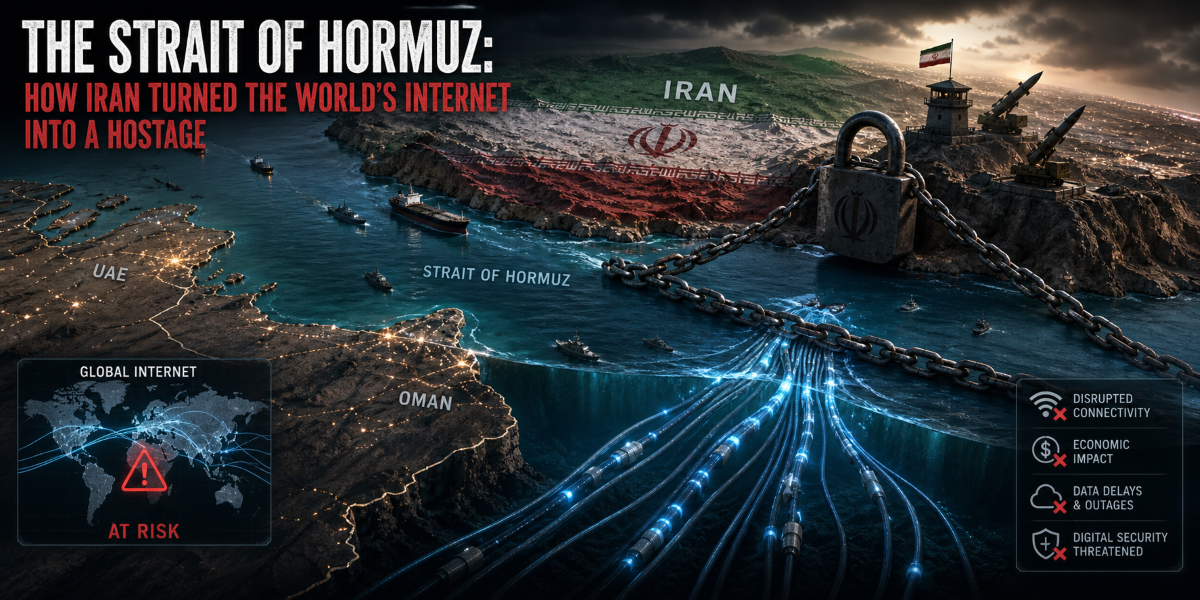
For decades, the Strait of Hormuz has been known as the world’s most dangerous oil tanker alley. Every day, about one-fifth of global petroleum passes through this 21-mile-wide chokepoint between Oman and Iran. When Tehran threatens to close the Strait, global gas prices spike, and navies scramble. It is a predictable, almost routine, dance of deterrence.
But in late April 2026, Iran changed the rules.
In a move that caught Silicon Valley, NATO, and global telecom executives off guard, Iranian state media published a detailed report identifying a new, even softer target: the undersea fiber-optic cables that carry the world’s emails, bank transfers, streaming videos, and military communications. The message was blunt. The Islamic Revolutionary Guard Corps (IRGC) did not threaten war. It threatened to pull the plug on the 21st century.
The question is no longer whether Iran can do it. The question is why the world left its digital nervous system lying on the floor of a military flashpoint.
Table of Contents
ToggleA “Weak Point” in Plain Sight
To understand the danger, you need to set aside the myth of the “wireless world.” Wi-Fi, 5G, and satellite internet are just the last few feet of a very long, very physical chain. The real internet is made of glass. Nearly 99% of all intercontinental data travels through roughly 550 undersea cables, many as thin as a garden hose, wrapped in steel armour and resting on the ocean floor.
Most of these cables follow predictable, peaceful routes across the deep ocean, safe from anchors, sharks, and soldiers. But a critical few have no choice but to squeeze through maritime bottlenecks.
The Strait of Hormuz is the worst bottleneck of all.
According to telecom infrastructure maps, at least seven major cable systems—including the Europe-India Gateway (EIG), the Falcon cable, and the Gulf-to-Asia connections—converge in the strait’s shallow waters, often no deeper than 200 meters. That is shallow enough for a diver with bolt cutters. It is certainly shallow enough for a midget submarine or a Revolutionary Guard patrol boat dragging a grappling hook.
For decades, military analysts assumed Iran would only target oil tankers. That was yesterday’s war. The IRGC’s own media outlet, Tasnim News, admitted as much on April 22, 2026, publishing a map and an analysis describing the strait as a “digital weak point” for the global economy.
In diplomatic terms, that is not a warning. That is a loaded gun on the table.
How the Attack Would Work (And Why It Would Be Catastrophic)
Let’s be clear about what Iran has not done—at least, not yet. As of early May 2026, no global cables have been cut. The world’s internet is still running. But Iran has seized three commercial vessels in the strait within the last two weeks, a clear demonstration that it controls the waters. The next vessel it stops might not be carrying oil. It might be a cable repair ship or a tugboat dragging an anchor across the seabed.
Imagine the following, very realistic sequence:
At 2 a.m. local time, two IRGC fast-attack boats slip out of Bandar Abbas. They approach a charted cable junction point, designated in open-source shipping databases. Using a weighted grapnel hook, they snag a bundle of cables. Within minutes, internet latency between Dubai and Mumbai jumps from 20 milliseconds to 2,000 milliseconds. By sunrise, streaming services in Pakistan buffer endlessly. Stock exchanges in London see fragmented data feeds. By noon Eastern Time, half of India’s financial firms have switched to backup satellite links—slower, expensive, and easily jammed.
Repairing a cut cable in the deep Atlantic takes weeks. Repairing a cable in the Strait of Hormuz, directly under the nose of Iranian shore batteries and minefields, takes as long as Iran allows. The last major cable cut in the Red Sea (2024) took five months to fully fix due to security delays.
In other words, Iran’s threat is not about destroying the internet forever. It is about holding it hostage for a season—a season of negotiation, of sanctions relief, of political leverage.
Why Now? The Context of April 2026
Iran’s threat did not emerge from a vacuum. It is the direct result of a devastating 40-day U.S.-Israeli military campaign that began in late February, which reportedly killed Iran’s Supreme Leader Ali Khamenei and severely damaged nuclear and military sites. Pakistan brokered a fragile, indefinite ceasefire on April 8 and continues to hold as of this writing.
But ceasefires do not produce trust. They produce leverage-seeking. Tehran has realised that its conventional military is outmatched. Its proxies are depleted. But its geography is eternal. And that geography now sits atop the world’s fibre-optic nervous system.
The Iranian calculation appears to be brutally simple: You can bomb our centrifuges, but you cannot bomb our seabed. And if you push us, we will remind your citizens what life looks like without Netflix, without Zoom court hearings, without automated banking.
The Trojan Horse Inside Iran
In a strange twist, Iran also claims to have discovered a different kind of digital weapon—one already inside its own borders. Earlier in April, Iranian cyber officials alleged that large amounts of U.S.-made networking equipment from Cisco, Fortinet, and Juniper Networks, installed in Iranian government and military facilities, simultaneously failed during the U.S.-Israeli offensive. Tehran described it as “deep-seated sabotage” and “hidden backdoors” pre-installed by Western intelligence agencies.
There is no independent verification of this claim. Iran has some of the most restricted internet access on earth, and its domestic intranet (the National Information Network) makes outside auditing impossible. But the allegation matters because it shows Tehran’s mindset. It believes that the West has already weaponised digital infrastructure. Therefore, Iran feels justified in weaponising physical infrastructure.
A Digital Threat Without Precedent
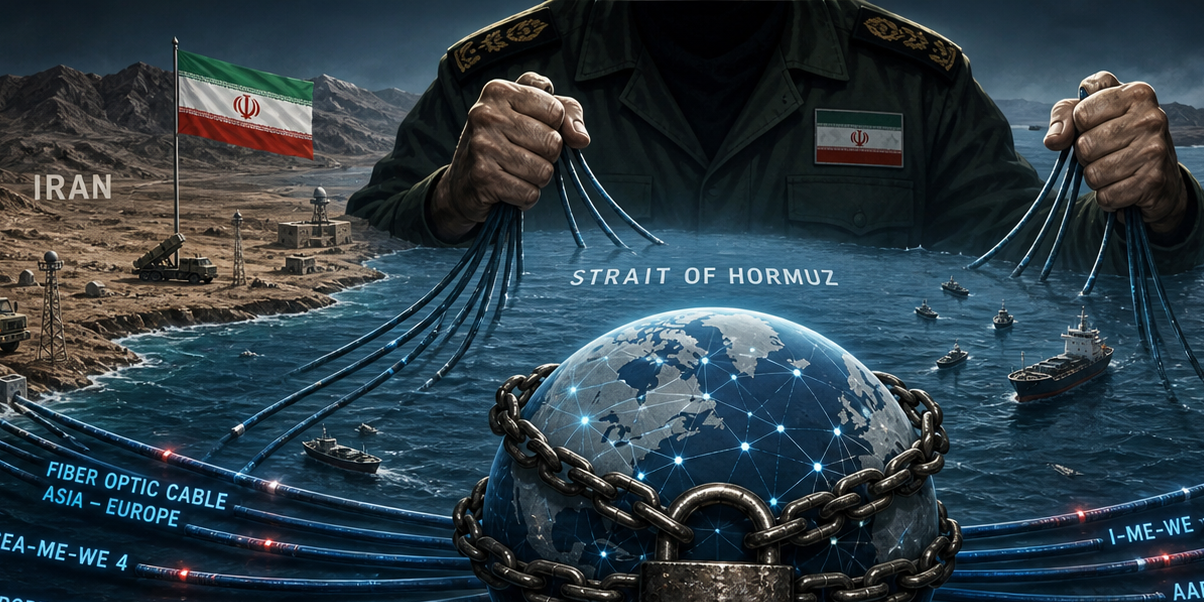
Nuclear threats come with red telephones and arms control treaties. Cyber threats come with firewalls and patches. But a threat to cut physical cables in a contested strait falls into a grey zone that no international treaty adequately covers. The United Nations Convention on the Law of the Sea (UNCLOS) guarantees freedom to lay and repair submarine cables, but it offers no enforcement mechanism if a coastal state decides to ignore those rules.
Iran knows this. That is why it published the threat openly, in English, for the world to read. It was not a leak. It was a notice.
For the average internet user in New York, London, or Tokyo, the danger feels abstract. We imagine the internet as a cloud. It is not. It is a series of glass tubes on a muddy sea floor, vulnerable to any determined navy with a map and a grappling hook. And for the first time in history, a hostile state has openly admitted it is thinking about cutting them.
Conclusion: The Fragile Cloud
The Strait of Hormuz has always been a place where the world’s economies hold their breath. Tankers slow down. Navies posture. Insurance rates climb. But until last week, the internet seemed immune to this ancient geography. We built our global village on the assumption that information moves faster than conflict.
Iran has shattered that assumption. The country did not destroy the global internet. It did something arguably more dangerous: it showed everyone else how to do it. From the South China Sea to the Bab el-Mandeb Strait, other nations are now watching, taking notes. The digital age has just acquired its first physical chokepoint—and it is not a firewall. It is twenty-one miles of saltwater controlled by a cornered, capable adversary.
Frequently Asked Questions (FAQ)
Q1: Has Iran already destroyed global internet services?
No. Iran has threatened to cut undersea cables but has not done so. The global internet is still running as of May 2026.
Q2: How much internet traffic goes through the Strait of Hormuz?
About 30% of global data traffic between Europe, Asia, and the Middle East passes through at least 7 major cables in the Strait.
Q3: Could satellites replace these cables if cut?
No. Satellites lack the bandwidth. One undersea cable carries thousands of times more data than all commercial satellites combined.
Q4: Why can’t the cables be rerouted around the strait?
Geography. The only alternatives add 10,000+ miles and massive delays, making fast internet impossible.
Q5: Should average internet users be worried?
Not immediately. But a prolonged cut would cause noticeable slowdowns for streaming, gaming, video calls, and banking across affected regions.
Q6: What can protect these cables?
Naval patrols, burying cables deeper, and international treaties. None of these is currently in place in the Strait of Hormuz.